Going abroad has to be one of the most fulfilling things I can possibly imagine. Being here in Indonesia has been such a treat, an experience to remember for sure! There have been lots of busy moments (working in rice fields), slow moments (waiting for the regent), horrible moments (bus ride to Bali), and not to mention lots of reflection time.
I value reflection time the most, the time when I get to rethink life and what I want to make of it. Recently, I have been so inspired by the people here (this culture), that I really want to know more about my own. This goes deeper than looking up my family tree, or reading books about African American heritage (although, it wouldn't hurt), but traveling to the Motherland, Africa. There was a question that was repeatedly asked during our time here in Indonesia which was, "What country do you plan to visit next?" Before, I was quick to answer Japan because I speak the language, but now, I see differently. Religion and history is such a big deal here in Indonesia, just as it is a big deal to me and I want to feel a relation. Its almost as if going back to the Mortherland is the only way I can go forward and help other people, I need to help myself before I help others.
Just a thought,
Avery C.
Monday, June 1, 2009

From the Temple to the beach to... a blackout???
Yesterday morning we went back to the Temple to join 30 or so Balinese children in their Pesraman activities. I joined the Balinese girls as they wove palm branches into egg holders and what I guessed were rice holders. Although it took me a couple minutes to catch on, eventually I became quite skilled at weaving the branches... but then Ashley and I had a palm branch weaving competition and she won. I'm attributing it to the fact that she is majoring in art. After that the children had a drawing competition: some filled in outlined pictures with colored pencils while others drew their own pictures. To me, the real competition seemed to be their drawing boards. They were drawing on boards featuring Spiderman, Dora the Explorer, and other characters from movies and television. All in all, it was a wonderful way to spend the morning.
Then, in the afternoon, we went to the beach! Sanur beach is beautiful, with warm, blue water, colorful sailboats near the shore, and delicious gelato. In fact, the only unpleasantness that I encountered was at the beach area of one resort/hotel (which shall remain nameless). We attempted to settle down there but were banned because we were not staying at the hotel; the hotel's security guard followed us down the beach all the way to the end of their property to make sure we left. We then proceeded to settle down about ten meters from the edge of their beach space, mainly because that was the only available beach space left. :)
As we were all getting ready for dinner in the evening, the lights suddenly went out. At first I thought that just our hotel had lost electricity, but we found out later that all of Bali (and maybe even Java) was affected by this blackout. We didn't have very much light as we were leaving for dinner, because the sun sets early here and not many of us had flashlights, so Stephen turned a corner without thinking and suddenly found himself in the stream that runs next to our hotel. (Ever since the first day I was here I had a feeling someone would fall in, because pedestrians really are not protected from falling in the stream by an substantial fence or ledge in some places). But then we wrapped the evening up well, singing songs from The Sound of Music on the way to dinner.
Until next time,
Sarah
Then, in the afternoon, we went to the beach! Sanur beach is beautiful, with warm, blue water, colorful sailboats near the shore, and delicious gelato. In fact, the only unpleasantness that I encountered was at the beach area of one resort/hotel (which shall remain nameless). We attempted to settle down there but were banned because we were not staying at the hotel; the hotel's security guard followed us down the beach all the way to the end of their property to make sure we left. We then proceeded to settle down about ten meters from the edge of their beach space, mainly because that was the only available beach space left. :)
As we were all getting ready for dinner in the evening, the lights suddenly went out. At first I thought that just our hotel had lost electricity, but we found out later that all of Bali (and maybe even Java) was affected by this blackout. We didn't have very much light as we were leaving for dinner, because the sun sets early here and not many of us had flashlights, so Stephen turned a corner without thinking and suddenly found himself in the stream that runs next to our hotel. (Ever since the first day I was here I had a feeling someone would fall in, because pedestrians really are not protected from falling in the stream by an substantial fence or ledge in some places). But then we wrapped the evening up well, singing songs from The Sound of Music on the way to dinner.
Until next time,
Sarah
Saturday, May 30, 2009
From Field to Mouth.
After a long (25 hours to be exact) and adventurous (to put it kindly) bus ride, we arrived back in Bali on Thursday morning. It would be an understatement to say that all of us were relieved and thrilled to be back in this paradise. We began our time back in Bali with a wonderful meal that night at Buddha Bali, followed by a full nights rest that we all were really in need of. On Friday we had the opportunity to work in one of the local rice fields and it was actually owned by one of our upcoming home stays. This was something that none of us have ever experienced before, and I felt completely exhilarated to take part in something that is such a core component of the culture here. The fields were muddy, a few of us fell in while walking along the small paths to get to them, and we significantly struggled to plant the customary perfect grid lines, but when it started to rain, we were pleasantly surprised to hear that it is considered a blessing. After we finished assisting with the small plot, we were taken to a much larger rice field that contained the village's temple used for crop blessing. While at this field we were able to walk far into it and observe harvest. We all were even able to sample some of the rice directly from the shell and I can personally say that is the closet I have ever encountered food in its process from the earth to my mouth.

I doubt any of us will ever forget that experience or what we have learned here from local farmers. I certainly have developed a much greater appreciation for the food I consume not only here but every day.
-Meghan

I doubt any of us will ever forget that experience or what we have learned here from local farmers. I certainly have developed a much greater appreciation for the food I consume not only here but every day.
-Meghan
What Isn't Said, Tells More
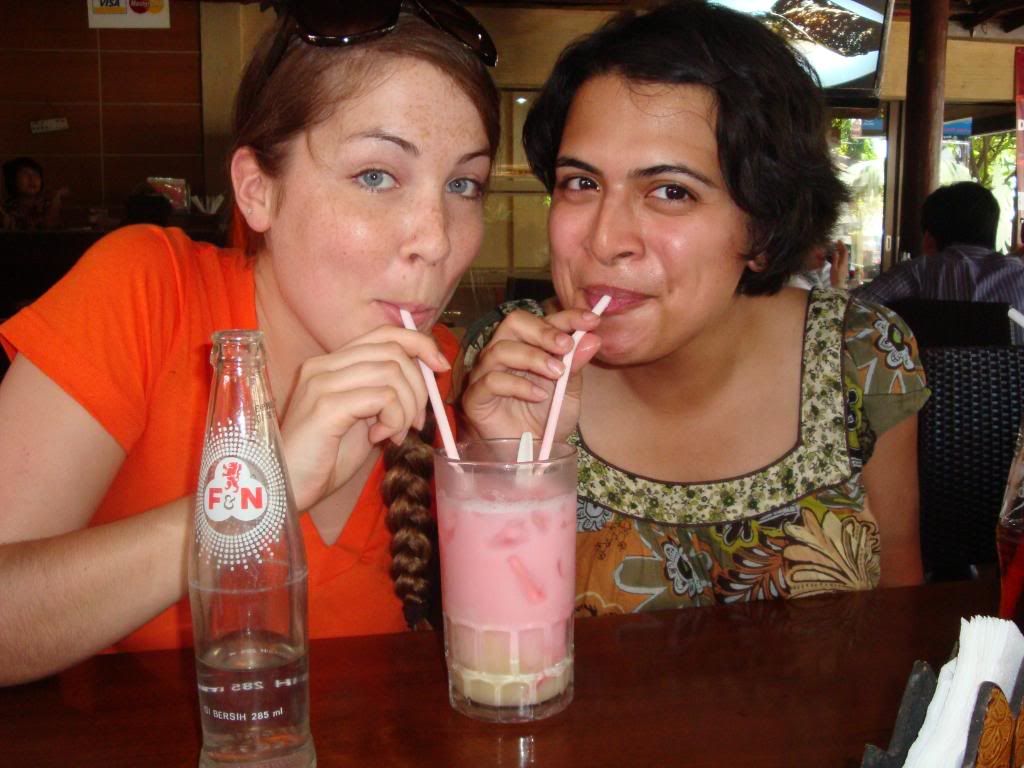
look, that's me (right) and jill drinkin' some es soda gembira,
or "happy soda," in Bali. it's a picture from the beginning of the trip, but one
of the very few i was able to upload when we had slightly faster internet in yogya.
okay. agustini said we lacked pictures on the blog. there's the picture. :)
Oh, hey there, dedicated blog reader. After a week or so in Yogya and a 25-hour, roach-infested bus ride, Team Indonesia is back in Bali. As much as Yogya had to offer with its city scene, returning to an island where the culture is integral and very visible in the workings of daily life. (It also helps that Bali is much cooler than Java. And Bali is in the high eighties. I'm not even joking.)
We checked out the pesraman of the Pengosekan village today. Basically, it's a once a week, compulsory culture school for fourth, fifth, and sixth graders in the area. The costs are covered by the village fund, and the children are even provided some clothing and snacks. "What's the purpose of this culture school? What do they do, Nina?" Hold on, hold on -- I'm getting there! The pesraman teaches Balinese traditions; things like weaving boxes for rice offerings, learning the Balinese language, practicing yoga, and learning particular arts such as gammelan music and Balinese dance. It's usually held on Saturdays, so that's why we were able to visit and observe those fidgety youngsters at class. (Once again, we donned our sarongs for the occasion.)
The pesraman in this village follow a basic, established curriculum. Pengosekan's pesraman, according to the village leader we spoke with this morning, did not exist until 2005. In all honesty, I was taken back by this fact. Why didn't the Balinese in the Ubud have this before to share the complicated Hindu traditions in Bali with their children? The village leader, the Bendesa Adat Pengosekan, said that they really haven't seen tourism industry pull away older children from traditions as the children find jobs in hotels. "They still can go to the temple by themselves," Agustini translated to us. "A job doesn't mean they have to give up their traditions."
Sure, I'll buy that, but the independent twenty-year-old working in a hotel doesn't have the social structure -- the cranky grandpa, the jovial aunt, the stern mother -- to keep them involved in tradition. Again, I was amazed at how new the pesraman culture program was. It makes me think about how the culture on this island has evolved. In the past, the extended family was enough to teach and maintain traditions; now, they have a school to help share these valuable aspects of the culture. If anything, it illuminates that with the onrush of industrialization and tourism, there has been an impact on the people's ties to their culture in the modern world.
Food for thought. Just mull over that one for a while.
Peace, love --
Nina
We checked out the pesraman of the Pengosekan village today. Basically, it's a once a week, compulsory culture school for fourth, fifth, and sixth graders in the area. The costs are covered by the village fund, and the children are even provided some clothing and snacks. "What's the purpose of this culture school? What do they do, Nina?" Hold on, hold on -- I'm getting there! The pesraman teaches Balinese traditions; things like weaving boxes for rice offerings, learning the Balinese language, practicing yoga, and learning particular arts such as gammelan music and Balinese dance. It's usually held on Saturdays, so that's why we were able to visit and observe those fidgety youngsters at class. (Once again, we donned our sarongs for the occasion.)
The pesraman in this village follow a basic, established curriculum. Pengosekan's pesraman, according to the village leader we spoke with this morning, did not exist until 2005. In all honesty, I was taken back by this fact. Why didn't the Balinese in the Ubud have this before to share the complicated Hindu traditions in Bali with their children? The village leader, the Bendesa Adat Pengosekan, said that they really haven't seen tourism industry pull away older children from traditions as the children find jobs in hotels. "They still can go to the temple by themselves," Agustini translated to us. "A job doesn't mean they have to give up their traditions."
Sure, I'll buy that, but the independent twenty-year-old working in a hotel doesn't have the social structure -- the cranky grandpa, the jovial aunt, the stern mother -- to keep them involved in tradition. Again, I was amazed at how new the pesraman culture program was. It makes me think about how the culture on this island has evolved. In the past, the extended family was enough to teach and maintain traditions; now, they have a school to help share these valuable aspects of the culture. If anything, it illuminates that with the onrush of industrialization and tourism, there has been an impact on the people's ties to their culture in the modern world.
Food for thought. Just mull over that one for a while.
Peace, love --
Nina
A muddy encounter with the Priest...
Yesterday was one of my favorite days of the entire program so far. We had the honor of meeting with a Balinese Priest, Mangku Made Gina, to learn about his role in the Pengosekan village. He welcomed us into his home where we all sat on the tiled floor of the meeting platform, first listening to him explain what he does and then later asking questions to better understand the dynamic of the village.
His two main roles are to prepare and lead ceremonies in the village temple and also to control the farming activities and water distribution within the village. I find the whole system of irrigation in Bali to be fascinating; it's controlled by priests and has been successfully functioning for over 1000 years in a sustainable way. Mangku Made Gina is in charge of the social organization of farmers called the Subak which creates rules for farmers and controls the water distribution to each farm. There are rules for what farmers can plant, when they can plant it, and when each farm will recieve water. At first glance this system of rules and sanctions for breaking rules might appear to be overbearing, but in actuality it's a carefully calculated formula for mainting the precarious Balinese ecosystem and the economic livelihood of the people. By regulating the water distribution and farming activities, the priests ensure that each farm will get enough water and at the right time during the growing process. The Subak also helps to maximize harvests by controlling pests and diversifying crops. How amazing that people can live harmoniously with nature and it benefits the public health, economy and social lives of the community.
Despite the picture I just painted, there are certain challenges to the Subak system. Farmers might choose to use pesticides and tractors, which can deplete the fertility of the soil which the Subak system maintains. But at the same time these technologies can decrease the workload for farmers and allow them to yield a bigger harvest, in turn increasing their income. Would you continue to use traditional practices in your occupation even if newer techology existed that made your job easier and more fruitful? It's a tough question, especially considering all the factors that are affected by the answer.
After meeting with the priest we got a taste of what it's like to farm in Bali; we were given the chance to plant young rice in a padi outside of Mangku Made Gina's home! We watched as the farmer effortlessly plucked the perfect number of strands from the young plant and delicately but efficiently stuck them into the mud of the padi. It looked easy enough...but despite the fact that it rained while we were planting and this is supposed to be a blessing, our crooked rows and haphazard placement of the rice stalks was all too apparent in the end. It was very gracious of MMG to allow us to help plant the new padi and get a hands-on experience of the daily activities of a Balinese farmer. I thoroughly enjoyed getting knee deep in mud and planting the stalks which will someday feed someone in the Pengosekan village of Ubud...what an amazing day. :)
Jill
His two main roles are to prepare and lead ceremonies in the village temple and also to control the farming activities and water distribution within the village. I find the whole system of irrigation in Bali to be fascinating; it's controlled by priests and has been successfully functioning for over 1000 years in a sustainable way. Mangku Made Gina is in charge of the social organization of farmers called the Subak which creates rules for farmers and controls the water distribution to each farm. There are rules for what farmers can plant, when they can plant it, and when each farm will recieve water. At first glance this system of rules and sanctions for breaking rules might appear to be overbearing, but in actuality it's a carefully calculated formula for mainting the precarious Balinese ecosystem and the economic livelihood of the people. By regulating the water distribution and farming activities, the priests ensure that each farm will get enough water and at the right time during the growing process. The Subak also helps to maximize harvests by controlling pests and diversifying crops. How amazing that people can live harmoniously with nature and it benefits the public health, economy and social lives of the community.
Despite the picture I just painted, there are certain challenges to the Subak system. Farmers might choose to use pesticides and tractors, which can deplete the fertility of the soil which the Subak system maintains. But at the same time these technologies can decrease the workload for farmers and allow them to yield a bigger harvest, in turn increasing their income. Would you continue to use traditional practices in your occupation even if newer techology existed that made your job easier and more fruitful? It's a tough question, especially considering all the factors that are affected by the answer.
After meeting with the priest we got a taste of what it's like to farm in Bali; we were given the chance to plant young rice in a padi outside of Mangku Made Gina's home! We watched as the farmer effortlessly plucked the perfect number of strands from the young plant and delicately but efficiently stuck them into the mud of the padi. It looked easy enough...but despite the fact that it rained while we were planting and this is supposed to be a blessing, our crooked rows and haphazard placement of the rice stalks was all too apparent in the end. It was very gracious of MMG to allow us to help plant the new padi and get a hands-on experience of the daily activities of a Balinese farmer. I thoroughly enjoyed getting knee deep in mud and planting the stalks which will someday feed someone in the Pengosekan village of Ubud...what an amazing day. :)
Jill
Monday, May 25, 2009
spaghetti for breakfast in Indonesia
The end is closing in as I have 2 nights left with my host family here in Yogyakarta before returning to Bali. I have fared well in the random draw of cards. The children in my family are grown and now have homes of their own, so I'm basically alone with my ibu (mrs), bat (mr), and ibu's mom. As people in Indonesia are known to dote over their guests, I feel like the prized only child with grandparents saying, "eat more, eat more!" It's a nice change to be the center of attention, until I get asked about Obama's cabinet or women in US politics. Questions like these make me wish I was a PoliSci major, but then again, maybe not. I do love drawing my feelings in art school...
5 choice host family moments:
1. Breakfast is dinner, but with the added bonus of yogurt
2. The dog, Pepi's, beady eyes staring me down when I eat
3. Bat telling me that I need a rickshaw to myself because of my size
4. My host family having actually heard of Kalamazoo before
5. Learning Indonesian word-by-word with sassy, gun-shootin', can't see straight host Grandma
As awkward as it was at times to come "home" to a family of strangers, my host family did become a safe haven. It's the best sleep I've had since coming to Indonesia and I don't think I'll ever eat as much food in one sitting as I have in the past week (cross my fingers).
And finally, some recent developments:
- starting to rethink that whole move-to-a-busy-city thing
- prefer beverages to come in small sealed container with an attached straw
- impossible to stay up past 8PM
Until next time Yogya.
drawing you during important meetings,
ashley
5 choice host family moments:
1. Breakfast is dinner, but with the added bonus of yogurt
2. The dog, Pepi's, beady eyes staring me down when I eat
3. Bat telling me that I need a rickshaw to myself because of my size
4. My host family having actually heard of Kalamazoo before
5. Learning Indonesian word-by-word with sassy, gun-shootin', can't see straight host Grandma
As awkward as it was at times to come "home" to a family of strangers, my host family did become a safe haven. It's the best sleep I've had since coming to Indonesia and I don't think I'll ever eat as much food in one sitting as I have in the past week (cross my fingers).
And finally, some recent developments:
- starting to rethink that whole move-to-a-busy-city thing
- prefer beverages to come in small sealed container with an attached straw
- impossible to stay up past 8PM
Until next time Yogya.
drawing you during important meetings,
ashley
Sunday, May 24, 2009
Who needs a hotel anyway?
Hello! This week, I have been staying in a homestay with another GIEU member. At first, I was a bit nervous about everything. I hoped that I would say and do the right things and develop a bond with my family. After three days, I am very glad I was placed with Agung and Bu Wiwi. Last night/this morning were especially meaningful. Last night, we (Me, Sarah, Bu WiWi, Agung, their son and a servant) all went to the middle of the city and ate a traditional Javanese dinner outside of the palace. We sat on mats with other families and ate some of the best Indonesian dishes I have thus tasted. While eating, a four piece band played for us, taking requests and also playing Traditional Indonesian songs. The night ended with sweet teas and a performance by a traditional Indonesian Shadow-Puppet show. I came home tired but feeling overjoyed at what I had just experienced. The next morning, Sarah and I got up at 5:30AM and traveled with Ba WiWi to the daily market. What greeted us put all the farmers markets I have visited to shame! Most (if not all) of the food was picked or prepared that morning, often coming from wild sources! Talk about local food. The people at the market were warm and greeted me as if I came there everyday. Along the way, Ba WiWi explained the different tastes and uses of various fruits/vegetables, as well as some of the interesting dishes prepared around the market. That morning, we had fresh juice from Jackfruit bought at the market moments earlier. What a treat.
I am so lucky to be here in Indonesia. Not only am I growing close to 14 fellow students, I am forming a deep bond with Indonesia and the wonderful people that I encounter.
Best,
Stephen
I am so lucky to be here in Indonesia. Not only am I growing close to 14 fellow students, I am forming a deep bond with Indonesia and the wonderful people that I encounter.
Best,
Stephen
Subscribe to:
Posts (Atom)